Saturday, 26 December 2009

Things I've listened to most this year

This is a curious list of the 25 or so tunes I have listed to most since moving my music files to a new hard disc about six months ago (and resetting the play count).

I'm very surprised to see pianist Tord Gustavsen at the top, but then again. Paying ten pounds a month to emusic for the last year or so has meant that I have been able to download things on spec. Tord Gustavsen has been one of these finds. The music is ECM, nordic, ambient, jazz chillout music. The pace is often slow and deliberate, the tone moody and atmospheric, the harmonies and melodies soulful and jazzy. Tord is not up there with Brad Mehldau (genius!) but I seem to listen to him lot:
  • when wanting to doze on a train journey
  • when wanting to work on a train, cutting out the background noise but not really listening
  • on Sunday morning
There are few surprises and few changes of pace but it has grown on me and it I do pick up more each time I listen (or half listen).

Stablemates is a tune I spent studying in depth for a couple of months, writing and playing solos on the changes. Benny Golson writes quirky tunes with quirky changes. Tunes like this and Along Came Betty have provided me with a lot of inspiration - I never felt I have come across the definitive solo on this one. It has encouraged me to stop treating it like some kind of puzzle and to try and create a coherent melodic idea from beginning to end.

Another find on emusic, Simone Dinnerstein's recording of Bach's Goldberg Variations is very personal take, tender and meditative from the start with a very slow Aria. At the time she recorded it (at her own expense), she was teaching piano in Brooklyn. I like the fact that she does not try to impress through virtuousity. The music flows very naturally and it really brings out the best in the Bach's writing without ever getting in the way. Here's an interesting article on her and the recording from Slate.

I have been listening to Joe Henderson's Black Narcissus for a few months now. Joe's playing on this recording is quite understated and the tune itself moves from calm and almost wistful to something to something almost tempestuous on this version (from Power to the People). I like Herbie Hancock's impressionistic use of the Fender Rhodes on Ron Carter's bass part played up the top end. Coincidentally, the tuned up in the Saturday workshop I take with Geoff Simkins and has proved a nice workout for improvising over. I have subsequently head a version recorded a few years later with a much bigger band. It is surprisingly different, lacking the intimacy of the original quartet recording, but showing that a good tune is worth many treatments.

There are many recordings of Larry Goldings (Hammond B3) with the great Peter Bernstein on guitar and Bill Stewart on drums. As One is one of the most satisfying although, for me, the highpoint is seeing them on the Peter Bernstein Live at Smoke DVD where you can see every one of Peter's grimaces as he squeezes each note from the guitar.

Guitarist Joshua Breakstone has been a big discovery for me this year. This French recording, Memoire, is Joshua at his best. A sympathetic rhythm section including Michel Petrucciani's brother Louis on bass, a great choice of tunes and beautiful soloing throughout. Joshua's plays with poise throughout and shows what he has learnt in a career that has spanned almost four decades.

Surprisingly no Kurt Rosenwinkel in there, then the recent Reflections is his first release in almost two years. He's certainly been up there in the past with The Next Step and Heartcore, and I remember listening to Milton Nascimento's Club D'Esquina for almost a year when I got my first iPOD about five years ago.


Subconscious-Lee: Lee Konitz & Warne Marsh, 1954

Lee and Warne doing their thing impeccably well. Beautiful soloing, both individually and unison. The rhythm section swings along nicely but there is little direct interaction between the front line and the drums/bass. The focus on the melodic line gives it a slightly abstract/ethereal quality, though the lines themselves certainly swing.

Do The Math has some interesting essays on the Tristano school and its relationships with the wider jazz tradition.

Sunday, 6 December 2009

Kurt Rosenwinkel: "Reflections" reviewed

This is Kurt's first trio recording since his debut East Coast Love Affair on Fresh Sound in 1996 and is interesting because of its focus on Kurt the guitarist, rather than Kurt the composer or bandleader. I"ve listened to this most days since it arrived a couple of weeks ago and will probably continue to listen to it over the coming weeks as it is so rich and there is so much to listen to.

What intrigues me so much about Kurt's playing is that there are so many dimensions to it. Listening to, say, the opener Monk's Reflections, he is articulating the melody, accompanying the melody with chords, improvising with both chords and melodic lines, capturing a certain mood and striving to say something new. This is a pianistic approach and, it there is any obvious difference to his debut over ten years ago is that he has extended his harmonic range and technical facility in order to fully embrace this pianistic approach. It was George Van Eps who pioneered this approach to the guitar and provided an comprehensive set of studies (Harmonic Mechanisms for Guitar) for guitarists wishing to play what he called "lap piano". Kurt sounds as though he has dug deep into these studies in order to master this approach. I've often marveled at how Charlie Hunter can sustain a bass groove with chords and single-note lines. Kurt goes one step further, as he adds in harmonic improvisation. To my ears, this sounds like several chains of musical thought happening in parallel.

For this recording Kurt is joined by my favourite contemporary drummer, Eric Harland, with Eric Revis on bass. That said, the focus is on the guitar with the rhythm section primarily playing a supporting role. If the there is a theme it's that, overall the tunes are ballads - a mix of standards, Wayne Shorter, Monk and just one Kurt original, a re-interpretation of East Coast Love Affair.

Following the statement of the theme, Reflections swings through a set or improvised variations ending with a solo statement of the tune by Kurt in which the subtleties of his harmonic approach are to the fore. You Go To My Head consists of an intro followed by a statement of the theme with Kurt embellishing the spaces between the lines with some nice, pianistic flourishes, bringing to mind Bud Powell, and some rich harmonies remiscent of guitarist Johnny Smith.

Fall is a radical re-working of a Wayne Shorter tune that appears on Miles' Nefertitti album. Beginning with a loose, funky-ish drum pattern, the tune has no head as such. Kurt takes it's circular form and varies it subtly from one chorus to the next, moving the melody and accompanying harmony in a variety of directions. It's a tune I've played over again on several occasions just because I like its mesmerising effect. East Coast Love Affair begins with composed intro that imagine has developed over the ten or so years he has played the tune. The first solo is from Eric Revis, Kurt then plays several choruses that really sing and include some flashes of virtuosic brilliance that we would expect on any of his recordings.

The solo guitar intro to Monk's Ask Me Now is pure George Van Eps. Eric Revis plays a really tasteful solo. The next tune is perhaps my favourite, Wayne Shorter's Ana Maria - an interesting up-tempo bossa nova. I like it because the tune is beautiful and is not one I know. It has that nice mix that we would expect from Jobim's finest bossa novas - melancholia, thoughtfulness and an uplifting quality. The head of More Than You Know is another opportunity for Kurt to show how he can state a theme, provide interesting chordal flourishes and some spectacular double-time ornamentation. During the soloing, he plays some extraordinary lines but, wherever they go, he has a chord ready to provide some support. It's this kind of performance that sets Kurt apart from the crowd.

The final tune if You've Changed, a torch song that I always associate with Billie Holiday. Like You Go To My Head, it's primarily a nice arrangement of the tune, though it does not have the emotional depth of Billie Holiday's version.

Overall, very satisfying album. In contrast to his debut, it has a loose, unhurried feel, with less of a sense of urgency. Though restrained, it is illuminated by flashes of brilliance and it is certainly very expressive. Kurt's last album, The Remedy, highlighted his composing and the contributions of band members like Mark Turner; this album focuses on Kurt, the instrumentalist, but is as rich, diverse and satisfying as any of his albums.

Saturday, 21 November 2009

Joshua Breakstone Trio: "No One New" reviewed

Joshua Breakstone is a jazz guitarist with a distinguished heritage. Born in New Jersey in 1955, taught by the great bop guitarist Sal Salvador and gigging early on with the likes of Warne Marsh and Sonny Stitt, Joshua has kept up a steady stream of recording dates since the 1980s. Stylistically, he comes out of bop and you can hear traces of Kenny Kenny Burrell, Grant Green and Wes Montgomery. However, his sound is his own and his solos stand out for their compositional strength and quiet purposefulness.

I've recently been exploring his recording and believe that his most recent work on the Capri label is his best yet, particularly his album of French tunes, Memoire - The French Sessions, Vol. 2 with Bassist Louis Petrucciani (brother of Michel) and drummer Christian Salut; and his latest, No One New with Lisle Atkinson on bass and Eliot Zigmund on drums. Recorded in France, Memoire stands out for its laid back feel, whereas No One New, recorded in NJ, has a more intense feel overall.

No On New kicks off with a JB orginal Over-Done, a fast paced tune with several minutes of single note soloing, rich in ideas with each idea leading seamlessly on to the next. The solos culminate in eights traded between Joshua and Eliot. For Me is a straightahead mid-tempo tune. Strong melody and a beautiful balanced solo - at this tempo you can really hear the subtleties of expression, the tasteful choice of notes and the spot on double-time runs. JB's The Unknown One takes the tempo down another notch to a relaxing bass nova, the tune featuring some tasteful chord voicings. Lisle's Come on Baby has a nice tongue-in-cheek feel and features a fine, swinging solo by the composer. Blues Heretofore is a mid-tempo tune where Joshua and the rhythm section just lock together and play as one unit. Eliot's brushes work particularly well at the start and then he shifts the intensity up as he switches to sticks. Joshua's solos often quote other tunes, Sonny Rollin's Alfie being one caught here. In true Wes style, Joshua's solo culminates in some nice chordal soloing. No One New is is another fast tempo tune with a long, interesting head, followed by another nice workout and eights traded between Joshua and Eliot.

For me, the standout track has to be Jimmy Rowles' ballad The Peacocks. In itself a beautiful tune, this has a lovely pared down quality. There is very little reverb on the guitar and the dryness increases the sense of intimacy and intensity. There is no studio trickery to enhance the sound, just Joshua's art and his desire to express. Joshua plays very few chords in the piece but the soloing just pulls you in and guides you through the changes. There is plenty of space, very strong melodic ideas throughout and Joshua's bell-like tone never sounding better.

The album ends with a rousing, swinging version of Joe Henderson's The Kicker which, when I first heard it, had me reaching for the great version by Grant Green with Joe on Grant's Solid album.

Although there may not be anything startling new on this album, No One New is the culmination to date of a life's work and is a masterclass in jazz guitar trio playing. As such, it deserves to be listened to by any serious jazz guitarist.

As well as recording, Joshua gigs regularly, including tours of Japan a couple of times a year, and teaching. You can find out more from his website.

UPDATE! A couple of transcriptions of solos from the CD have been posted on Joshua's site:

Thursday, 19 November 2009

Kurt Rosenwinkel - new website

I really missed Kurt's website after the discussion forum was taken due to "hacking by Russians" (What is this? The Cold War?!). The forum was a great place to discuss Kurt's work and to chat directly with Kurt.

Kurt's website is now back: http://www.kurtrosenwinkel.com/

And he has a new CD out - playing standards, mostly ballads. This is the repertoire I saw him playing in London earlier in the year (see review below). What's more it stars my favourite drummer - Eric Harland. Kurt is no longer with Verve and this CD release is out on his own label. I've ordered it and look forward to reviewing it here.

Saturday, 7 November 2009

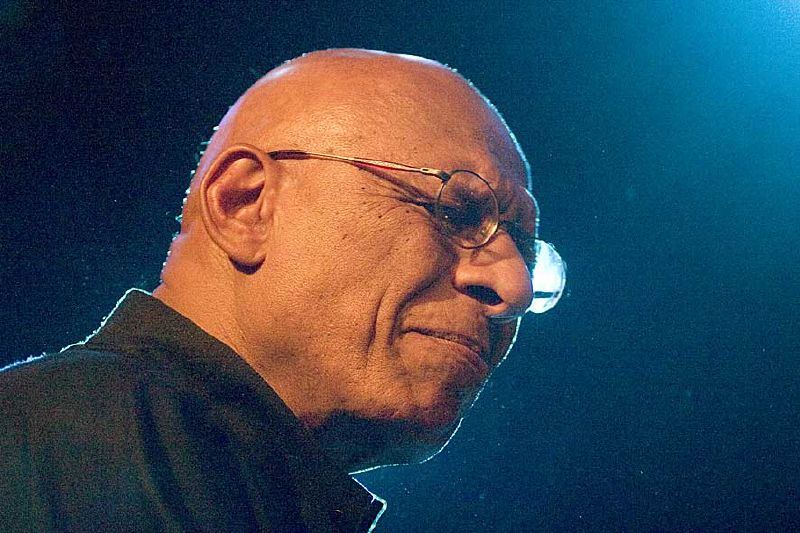
Kirk Lightsey Trio, Brighton Jazz Club, 6 November 2009

Last night US pianist Kirk Lightsey played with an energy and intensity that belied his years (he's in his Seventies). Kirk delighted the audience with a set that was passionate, joyful and virtuosic.

Elements of his playing include they way he balances hard bop soulfulness and with the harmonic complexities of Bill Evans. He has a fiercely strong left hand - jabbing away in a bebop style, playing arpeggios, melodies - giving a sense of a churning torrent of energy. His playing is peppered with quotes - Monk, Rachmaninov, Debussy, Oscar Pettiford, jazz tunes and standards.

The humming, growling and singing of his accompanying vocals (in the tradition of Bud Powell & Keith Jarrett), rocking on his chair, playing with outstretched arms, all give the sense that he is putting everything into his performance. Reinforced by his catch-phrase, "Woweee! If you're not having fun by now . . ."

His set included tributes to friends like Tony Williams (Peewee), Wayne Shorter (Infant Eyes) and Miles Davis (Freedom Jazz Dance). It one point he did a Debussy-like cadenza and segued into a beautiful version of the ballad Spring is Here which, despite his extrovert disposition had some tender moments and harmonies reminiscent of the Bill Evans' take on the tune.

As with all good piano trios there was a sense of conversation with the other two members, with some outstanding playing from a poker-faced Dave Wickens. Kirk constantly gave them visual and verbal cues (F minor!), laughed at the musical jokes, smiled with appreciation at their playing and made sure that the audience gave them well-deserved recognition. They did a rousing version of Dave Brubeck's In Your Own Sweet Way, which led into an extended drum solo by Dave Wickens with some very funny musical banter between Kirk and bassist Dave Whitford as they tried to synchronise the kicks at the start of each chorus of the drum solo.

This was one of the best gigs I have seen at the Brighton Jazz Club in recent years, with Kirk bringing a warmth and humour to the club's somewhat austere setting.